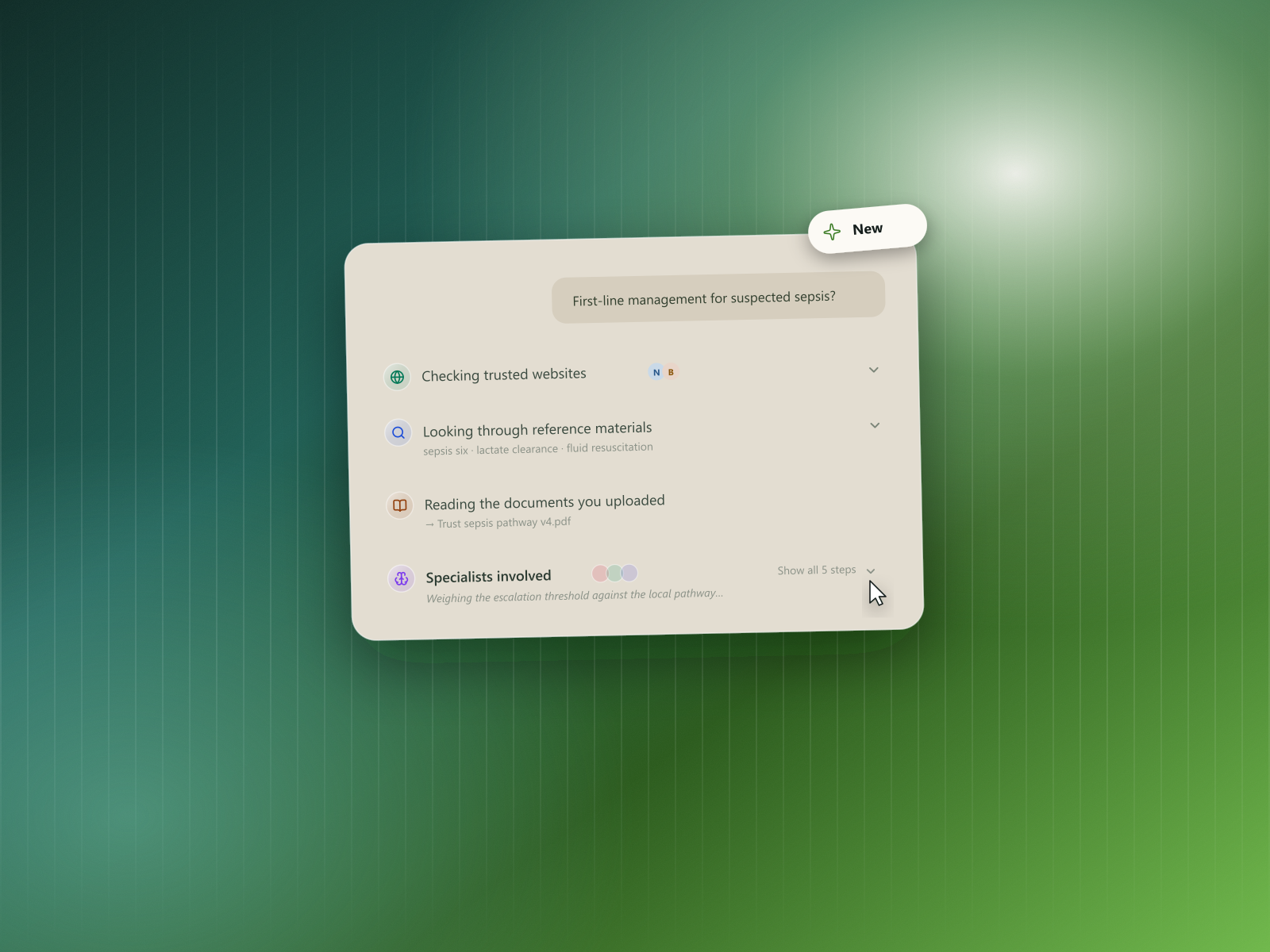
October was about showing the work: a new chat engine that researches properly and lets you watch it happen, plus recording and EHR work that stops losing what you'd already done.
A new chat engine, with visible steps
The engine behind every answer was rebuilt. The headline change is that research is now something you can watch happen rather than a spinner you wait behind — which matters when you're deciding whether to trust what comes back.
Search behaves like research, not a lookup. Instead of firing one query and summarising whatever came back, Rhazes can search, read what it found, and then search again based on what it learned — widening the search when the first pass is thin, and narrowing it when it finds the right source. The practical difference shows up on questions where the first page of results isn't the answer.
A Steps panel shows the work as it happens. Each step appears as its own row as it runs — checking trusted websites, looking through reference materials, reading the documents you uploaded, checking the patient record — with the sources it touched shown alongside it. Steps that gathered more than fits on one line expand for the detail, and the reasoning behind the current step is shown beneath it while it works.
Everything runs on the same engine, including documents. Document generation moved across too, so generated documents can follow your own templates rather than a fixed house format, and the same step-by-step visibility applies while one is being written.
- It's clearer which tools and sources went into a given answer, making it easier to double-check a claim without re-doing the research yourself.
- An answer in progress is now checkpointed as it streams, so an interruption doesn't necessarily throw away the work already done.
Dictation now survives a reload
- Recordings are now saved continuously as you dictate, instead of only once you stop — so a browser crash or accidental tab close mid-recording no longer means starting the whole thing over.
- If the tab reloads or the connection drops mid-recording, dictation can pick back up where it left off instead of losing everything you'd already recorded.
- Fixed several recording issues specific to Safari, so dictation is reliable regardless of which browser you're using.
EHR: redesigned patient linking and document import
- The add-and-link-patient flow from your EHR was reworked for clarity, so it's faster and less error-prone to get the right patient linked.
- The patient you're working with now stays in sync across every open tab — switch patients in one tab and the rest update with it, instead of each tab silently working with a different patient.
- A new importer lets you pull a document that's already attached to the patient's EHR record straight into your chat, so you no longer have to download it from the EHR and re-upload it by hand.
Faster homepage, longer sessions
- Submitting from the homepage now takes you straight into the chat, removing an extra loading step that used to sit in between and make the first question feel slower than it needed to.
- Sessions now refresh themselves automatically before they expire, so you should notice fewer unexpected sign-outs in the middle of a task — no more losing your place because a session quietly timed out.
Fixes & polish
- Italic text in Rhazes's responses was showing literal asterisks instead of rendering as italics — fixed, so formatted responses now read the way they were meant to.
- Fixed an error that could stop a generated document from being refined or regenerated after the fact, so a follow-up edit to a document no longer risks getting stuck.


